I got inquisitive to know her drive to watch them. She told me “I like to watch visuals of people cooking and eating. I like to see vegetables being chopped, masalas stored in repurposed bottles, a fake kitchen that looks too true to be a lie, and wives pouring chutneys over husbands’ Idlis. It is only in these unassuming, everyday stories you get to watch the seemingly mundane stuff. Contemporaries lack that”.
Almost seven years later, I came across Igor Cusack’s essay on Equatorial Guinea and African cuisines where I read “the presence or absence of food in novels or poems is usually not noted by the casual reader”. It took me to that encounter with Ramya who watches cinema and arts for a sensory experience of food through visuals. She is rare and not casual in Cusack’s words. I’ve ever since been watchful of food in the movies. It led me to think that cinema and television have always been signaling to the audience minds’ implicitly with food in the frames.
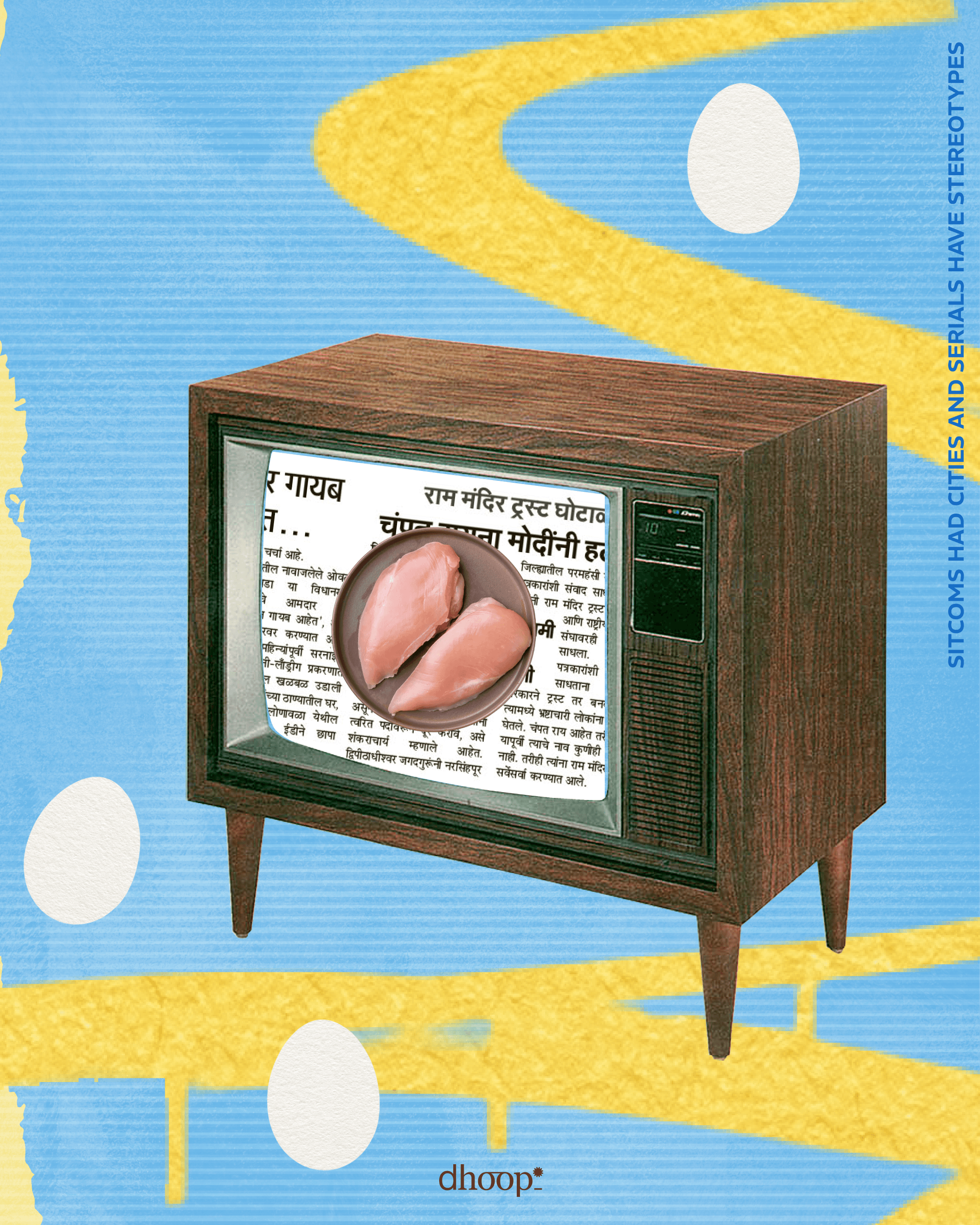
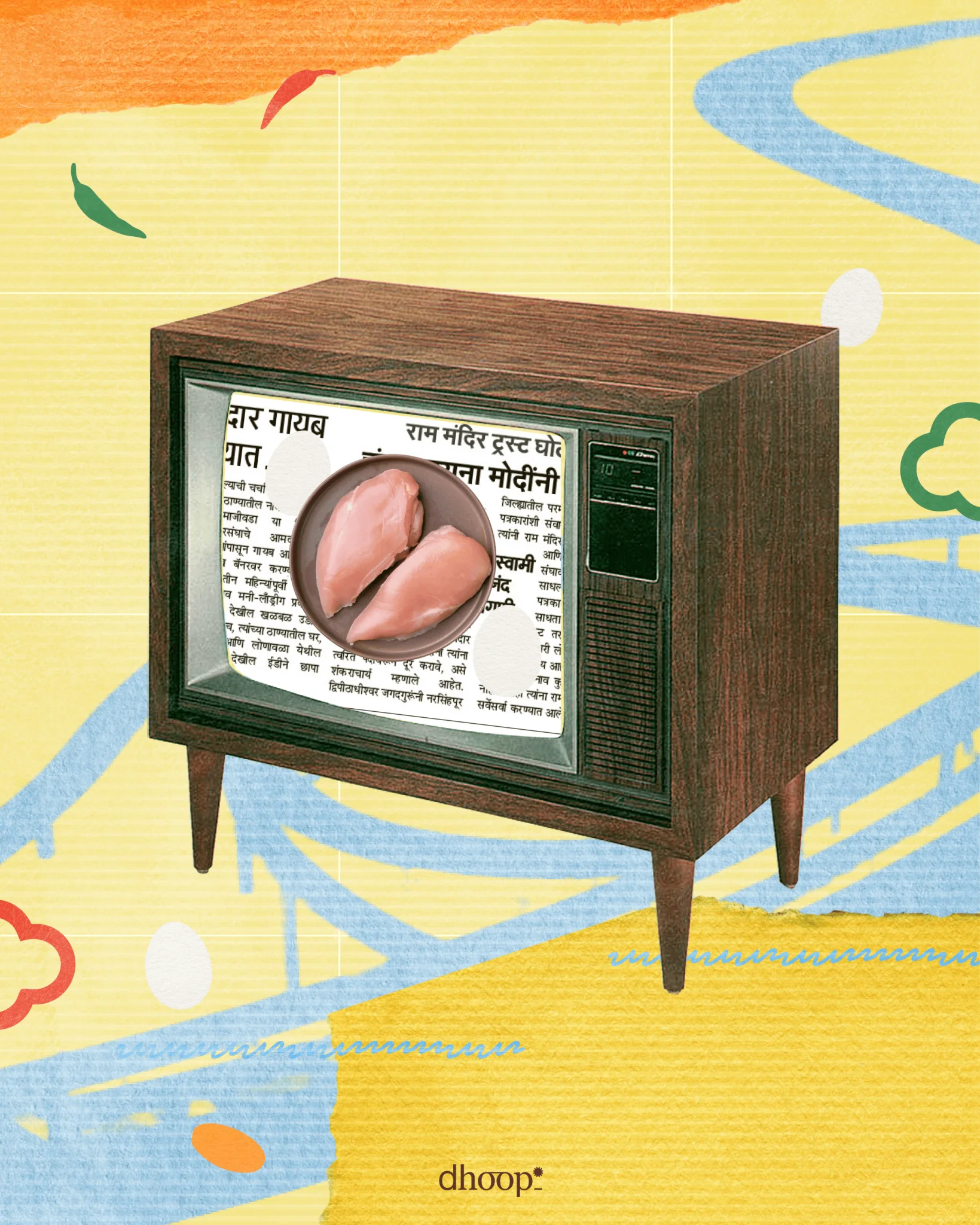
Revisiting old soaps from Prasar Bharti Archives on Youtube shocks a socially aware viewer noticing how narratives have changed on Indian television just in terms of food alone over the years. Middle-class families on television shows from this era, representing the average sample of the nation, discuss eggs and meat the same way they discuss vegetables. But today the sound of the word “meat” or the sight of eggs on the kitchen counter of a television show about “good” families is sure to shock its audience. It is because the TV world has reconfigured itself over the decades in order to disallow space for these foods. This is an ideal instance to how larger politics around hyper-nationalism connecting itself with vegetarianism has promptly infected the television in India. Borrowing Britta Ohm’s words from the essay “Televised Community: Culture, Politics, and the market of Visual Representation in India”, about television since the 2000s “the Indian soap opera can be seen not only representing the re-invention of television in its fully commercialized avatar in India but the re-creation of an image of the nation”. The imagined preferences of the nation are reflected in the visuals of contemporary Indian television.
But, rewinding through the early days of Indian soaps on television, I find out they were throttling with realities and less “idealistic”. Some DD classics like Zamana Badal Gaya (1995), Idhar Udhar (1985), Thoda Sa Aasmaan (1995) are my favourites to think about in terms of aesthetic that is enmeshed in the dailyness, culinary that sounds practical, and women who stand for themselves, unlike good women in television today, from the so-called good and cultured families.
Food as a metaphor in cinema and television look like two different things these days. While regional films, for instance Tamil cinema, has evolved in the showability of all kinds of meat production and consumption delivering it as an acceptable aesthetic, Indian soaps have turned their frames “clean” of meat. Unlike cinema, television is a quotidian. It engages with your visuals everyday and in many Indian households its soundtrack is nearly part of their soundscape itself. Oldsters glued to television screens is a typecast of Indian mid-mornings and evenings. But data tells Indian youth’s consumption of television has been on the rise since the 2020s despite rapid growth in digital media consumption. So, it’s alarming for the social observer in me thinking about the audience buying into the stereotypes and jarring aesthetics of binary in food – good that eats “clean”. The clean is carefully curated through settings in stories.
Some of those that would ring a bell are: a society of good people from all over the country in Mumbai where all the families are vegetarian whose kitchens clean, pure, and holy where even eggs could be a sign for antagonism. But, eggs feature in the title track of Idhar Udhar (1985), featuring the inimitable Ratna (Sunita) and Supriya (Poonam) Pathak. Idhar Udhar’s season 1 is a sleek 12 episode sitcom about two independent women with little interest for domesticity staying together as paying guests in a one-bed room apartment in Bombay. The narrative here is kind enough to not portray them unkind. In today’s TV, their way of life could well be treated as though they are bottomless cruel. One should not miss to note that Sunita, an airhostess, and Poonam, a media person, stayed as paying guests at a Catholic woman Ms Braganza’s place with a Parsi neighbour in a suburb in Bombay. When did we last see such Indian women playing in the front on our television screens? Or when did we last see Bombay in all its complexity and gaiety cosmopolitanism on television?
If one were to use contemporary television shows like Taarak Mehta Ka Ooltah Chashma as touchstones to create their idea of Bombay, with all-vegetarian migrant families, then they’d be terribly misled. If this isn’t a soft move to erase the diverse eating cultures and ultra-plural migrant experiences in Mumbai, then what is? But in the 90s television, Bombay as a migrant city looked different, ate from diverse food sources, and the ladies of the house had so much else to do than always gather at the society club house or cook for their husbands, like we see in TMKOC.

Has Zamana badal gaya once again?
A fitting family to remember here from that era is the Mathurs from Zamana Badal Gaya (1995) starring Aruna Irani (Veena Mathur) and Tiku Talsania (KL Mathur), that showed us a North Indian family’s life in 1990s Bombay. This is a story of an office-goer KL and home-maker Veena with their three children Ajay, Dolly, and Bobby whose lives revolve around their apartment, office, friends, and family. A migrant middle-class family that regularly ate Kachoris in the Konkan metropolis together with fried eggs, toast, and butter. The visuals around their kitchen, fridge, trees outside windows, hushed mornings, shots of sizzling sabzis, sounds of pressure cookers, views of halved-and-empty egg shells on the counter, packed lunches, a neighbour who drops by for the day’s newspaper, teen craze for sport star posters, golden hour lights from a tree-laden Bombay street when KL comes back from office, mid-morning drizzle and wet streets indicative of a Bombay July when Veena walks inside their compound with a friend. The sense of time i.e, 90s and also the space i.e, the city is fed to the watcher’s eye easily through these culinary and domestic objects. Like the time when KL tries to assert his indifference to an ongoing rough patch between him and Veena by eating a takeaway from Lucky Biryani upon a colleague’s advice, who had been doing that for years. Hell breaks loose when Veena finds out. What is noteworthy is the chance for the city to take part in the story in the name of its culinary metonymy, one of the many ofcourse, i.e, Lucky Biryani.
Another favourite to think about organically delivering Bombay aesthetic is Deepti Naval’s Thoda Sa Aasman (1995). Moss-ridden monsoon walls, Sikander the kite-maker for Sankranti, a church priest by the seaside village or Gaothan (tiny Catholic settlements all over the island of Bombay and Salsette) to whom a Hindu woman goes with a broken heart, a woman with the dream of a photojournalist, an old woman walking out of her marriage at her 70s, and above all overall Bombay families cooking meat and eggs like many many denizens of the city do everyday. There was real Bombay on screen without the poor aesthetic mood-boarding that we see today in serials.
90s shows also saw women cooking for their families. But instead of reinforcing antiquated gender roles, they questioned it. For example, Zamana badal gaya questioned it by having an episode where Veena’s old friend visited her, made her pause, and allowed her to brood about herself that lives to serve others, made her resume cycling, playing tennis, watch theatre, gave back her old spirits, and nearly set her free. The episode was a willful addition for its women audience to brood about their domestic routines like Veena and a mild knock on men’s heads. Instead of rendering the lady of the house as the keeper of culture, which we see so much in our televisions today, Zamana Badal Gaya did the opposite.
But what happened to our screens from the 90s and its audience? It can be proved that our mainstream art is dwindling in quality and creation by comparing the television shows from the 80s and 90s to those of our own day. An average television watcher’s mind has been trained to accept unreal as true, impossible as ideal, and unfair as the righteous. Examples are the derangement of the city of Bombay forgetful of its composite identities, transition of Indian family’s portrayal from an average middle-class to Star Parivaars, their women reduced to Bhabhis has pushed womanhood to the perils of being sacred and self-righteous. In other words, a bunch of anachronisms strung together. This is what media studies experts like Stuart Hall call as the repeated framing of once contested ideas into common sense. He theorises this particularly with the instance of television discourses in his Encoding/ Decoding. A select few’s dangerous ideology is being fed to us as a benign culture. What will an average watcher like Ramya buy from such shows, with glaring binaries, devoid of grey? Can a show like Zamana badal gaya be remade today? Will that be a sequel or a prequel? A prequel set in the 19th century to season 1 made in the 1990s would be a top fit for our Indian television today.