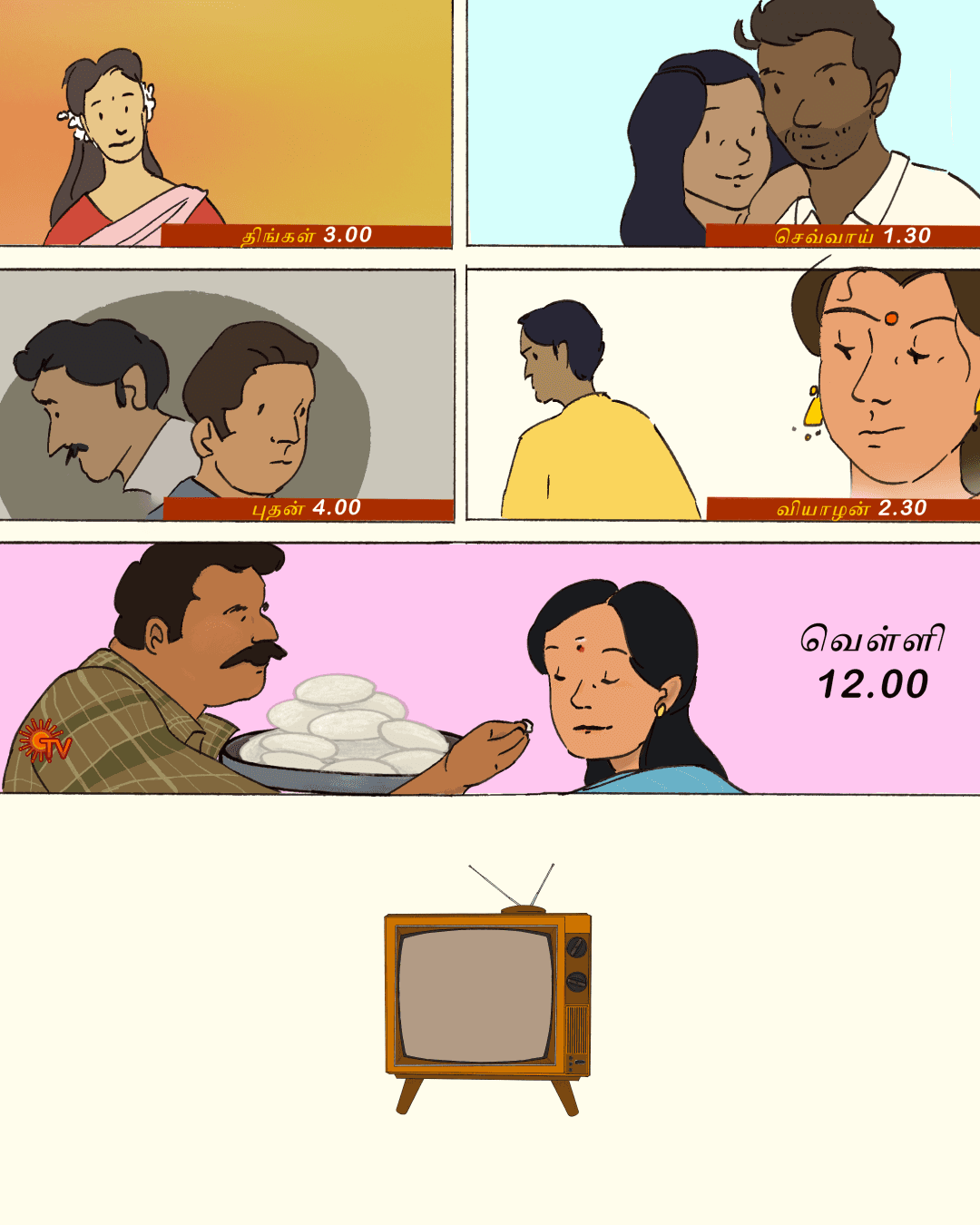


No retelecast and nothing traceable on the internet, well the internet itself was still futuristic. So, Sun TV, the most watched in Tamil households during the era, announced its movie roster a week ahead to avoid missing shows. The channel’s matinee telecast between 1.30 and 5 pm had a theme to each day. Comedy on Mondays, romance on Tuesday, classics on Wednesday, action on Thursday, blockbuster hits on Friday. A few tens of films that the channel shuffled across time and occasions to telecast year after year. Sometimes the masala was so diverse in a film that it could fit into all of the five themes. Suryavamsam (1997) in early 2000s was such a case, a promising excitement to watch. I was a die-hard fan of the film (time to wince) that follows an unambitious man Chinnarasu (Sarath Kumar) turned into a tycoon and an IAS aspirant Nandini (Devayani) becoming a collector in countryside western Tamil Nadu.

Older cousins would usher me days before the telecast seeing the promotional roster. “Your favourite heroine and song movie on Friday afternoon, don’t miss”, a cousin living two houses next to us would come on call to our landline on a Sunday mid-morning, to save me from missing the watch due for telecast on the upcoming Friday. Without a mention of the name, I’d know it.
The film has a generational fanbase that even those who pull back to consider it a poor taste of cinema wouldn’t disagree that it was a definitive milestone in the Tamil pop-culture. But it became legendary in Tamil mass culture for two iconic memories. One for its idli upma recipe and the other is the rise of the runaway couple, the movie’s leads, becoming a millionaire and an IAS officer – all in the time of one song. The number was a hit – briefly famous and obscurely dead until the internet era dragged the thing back to its cultural consumers. But the idli upma didn’t require internet-level constant memory re-establishment to touch all the corners of Tamil existence. In fact its virality predated the upcoming internet epoch, making one think if recipes are by-birth mobile, that it can never stay with one person or place, even if that is from a film. Thus, Tamils across that pop culture sphere got their OG viral hack with leftover idlis.

The famed “idli upma” scene and the movie itself is set in western Tamil Nadu, which is Tamil cinema's most respected landscape. If Madurai and southern parts are reserved to play the site of violence, the west side Coimbatore, Erode, Salem parts and their villages are the light of mainstream Tamil creations. The region’s green geography is co-operative to this imagination, to idli upma setting as well. The scene set in a farmhouse surrounded by acres of greenery extracts an air of seclusion and peace aptly to pair with the quiet intimacy of recently eloped Chinnarasu (Sarathkumar) and Nandini (Devayani), both children of rich fathers. Chinnarasu feeds Nandini, holding a tumbler of water and a plate of idli while Nandini demonstrates gentle womanhood, refusing the last few bites with marudhani (Tamil for henna) in both hands. Enters Nandini’s father for the first time after the couple’s eloped wedding, white and white in a suit, to contrast the hero’s father’s image of veshti and rurality. His character is unwillingly henpecked but otherwise warmhearted. Nandini’s mother, gravely provoked by her urban-bred daughter’s choice to marry a rustic rat Chinnarasu, doesn’t visit. Welcomed and hosted, father is invited to eat. But then, Nandini sees only a few leftover idlis. She knows what to do next. Facing the window in her airy kitchen, on her gas stove, she places a kadai, splutters what looks like mustard, green chillies, and chopped onions before she tears her idlis roughly to add to the kadai.
This recipe takes me back to this thought often. Was it Suryavamsam’s invention or did people do that in western Tamil Nadu, where the film is set, which got popular throughout? I was four years old in 1997 when the film came to infer any anthropological speculation about it then and now. So, I did a bit of internet search. All I found as a close recipe on the old-time Kannammacooks blog, a western Tamil Nadu cuisine major, was a recipe for pasipayiru upma (Moong dal upma) which requires you to soak green moong dal overnight, batter, make idlis, and then shred to make upma. But, we don’t really know anything else.
When Nandini serves it to her father, he is moved by her culinary common sense. In his mind’s eye, sitting on the floor with his over-done conference attire, meant to present him as urban, he enters a reverie. He sees his daughter in her past life walking next to a fleet of colourful cars in an even more jarringly colourful outfits, moderately outdated sunglasses with hair flowing from front to back and vice versa in two briskly edited shots. Reclaiming senses, his eyes brimmed, proud of his daughter salvaging idlis to handle nothingness, leaves as a happy man.

It is intense domesticity. The recipe was a blockbuster hit though Nandini explains it in not more than two sentences in the movie. It is that kind of a recipe that is tried for the amusement of lazy teens and beginners. Unless there is an intention to, it couldn’t get wrong. Most Tamil households, at least once must have tried their hand at this because leftover idlis is a situation no one could escape from, forget categories. But there is more to read from it.
What looks like an exhibition of frugality and brilliance in domesticity through idli upma isn’t just that. Nandini is introduced to us in the film as an IAS aspirant, a preparatory seed to her character arc. But her father’s emotional culmination in the idli upma scene, mid way in the movie, isn’t forgetful of her aspiration, but confirms to us the priorities of respectable femininity. That a woman needs to excel at home before elsewhere. Like Laura Mulvey writes, the slow and steady edits of that scene are “patriarchal economy of images”, in her essay “Visual Pleasure and Narrative Cinema”. Though the essay was written with Hollywood as a central focus, Amanda Weidmann in “Vision, Voice, and Vinematic Presence" written with Tamil cinema as a primary subject, allows the thought to be expanded to all forms of narrative cinema.
Idli upma belonged to a diegetic world. It is a diegetic recipe. But through the fourth wall, it entered homes and offered a solution to our decaying idlis. With that, has it given for free the deserved-to-be decayed ideas on womanhood? Well, it was 1997 and gone are those days one might think and say. But we do know the power of mass-appeal movies. More so in a state like Tamil Nadu, that for too long, has been searching its CMs from the cinema screens.