
Just then, my phone rang. My grade 2 daughter’s friend Yugasri’s mother. “Our cow has yielded a calf. I’ve colostrum milk for you. I’m on my way to your home,” she said in a straight voice. I informed her that I’m out of town, in Bangalore, and that my family in Kayalpatnam would be at home to receive it. I felt bad for my inability to accept it with full warmth by being there physically because the last time Yuga’s mother called me was to check if she could bring me a portion of cooked mutton that was offered to their family deity. With difficulty, I gently refused. Then ensued the usual overload that runs to sit on my shoulders, when I rebuff a friend’s non-halal meat, on the pretext of wanting to be deemed communal. My favourite point to inform them is that my family for three to four generations, as far as I know, have been sourcing meat from non-Muslim butchers in Kayalpatnam. It is only the slaughtering that needs to be made in the name of Allah, the god we believe in, and nothing else to do with touch or hierarchy of the doer of the deed i.e, the slaughtering. I have no idea how my friends like Yuga’s mother have taken to it but all have thus far given me a genuine nod of understanding.

I turned back from that reverie to join Rini in finding. But the call was an intervention. On an evening to be spent on discussing food and the systems that make it, the reminder to my old deed — refusal to eat meat that is not halal from the hands of the same producer that rears my halal meat’s animal — was an itching unease. For the Hyperlocal issue to be launched that evening, I had written on the transactional nature of communities rooted in a place through the story of a dish from Kayalpatnam. So, I took the call that ended to open to me my shallowness to my awareness of the food system I think I can write about. It was to tease my writing confidence which I thought came from the God I believe in — the God at the kernel of my culinary sphere.
From there, no one else’s culinary and consumption decisions looked of immediate importance for an urgent probe than my own. Do I really believe in halal for faith or is that a cultural hand-me-down that I’m afraid of abandoning? As an individual invested in the questions of food production, I’m accountable to myself for these decisions and subsequent culture-making that I partake in. I wanted to find out between my person and persona where my choice of halal meat lies.

Animal sacrifice and consumption of that meat among traditional food producing communities like the agriculturalists, pastoralists, and fishers is at the heart of godly rituals designed around resource pooling, food rationing, and the anxiety around decay. Ceremonial slaughtering in front of a deity aimed at sharing the parts of the animal with all the stakeholders of the shrine or the temple is straightforward common sense because the carcass decay starts the moment it loses life. A rationale in ration. If I reject meat slaughtered in a setting that was birthed centuries and millennia back to create sustainable living systems, then do I also negate their logic? How can such a rudimentary bedrock of the food system be negated? How to contextualize a religious belief birthed in a different land into another land that has other frameworks to life and society? I wanted to know it neither from a religious scholar nor her food counterpart, not even from the butcher. So, I went to the herder because no one knows the animal like him. I know talking to a herder isn’t knowing the system fully. I’m neither attempting it. Probing the system isn’t what I want out of this. .So, I went to a herder.
The herder is Yuga’s maternal grandpa Arumugam Ayya whom I respectfully call Appa (Tamil for father). They are a traditional herding family. There is no wall between work and life to him and his family like there is no wall between their cattle and their living quarters.

June evenings are long in our parts and that evening we sat moments before the golden hour to chat inside their living quarters which is right beside their animal barn, kitchen, and an open kitchen garden with plants and flowering trees. In a few minutes, Ayya’s wife, Yuga’s grandma, sent us from the kitchen a big vessel of ginger tea, three empty steel tumblers to pour in, and a plate of mixture, that sat in the middle as an essential third presence.
In a contemplation to organize this piece as a full-interview between me and Arumugam ayya, I decided not to. Our exchange kept converging into a mishmash of family and work with unsayable amounts of personal stories, way too much for the readers to know. Yuga’s mother Muppadathi, an HR consultant, who very well understands my work, broke down in simple words to her father about my work and why I want to talk to him. What I intellectualize with hyphenated-words about animal rearing and meat slaughtering, Ayya wrapped in a single phrase: paatha than aadu, paakalenna chemmadu (it’s a goat only if you care for it, otherwise its nothing, meaningless) with a thumping rhyme of the words “aadu” and “chemmadu”.

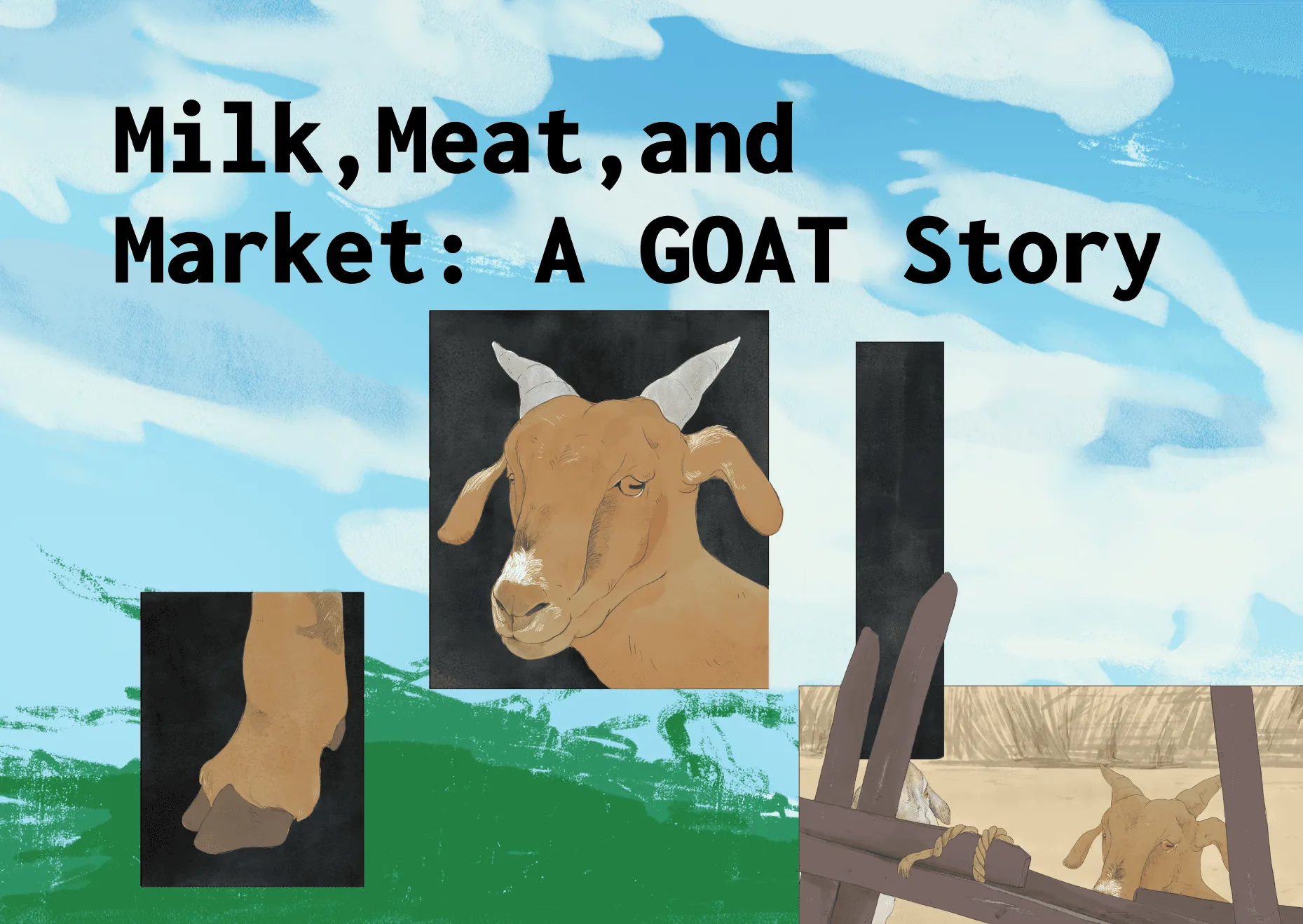
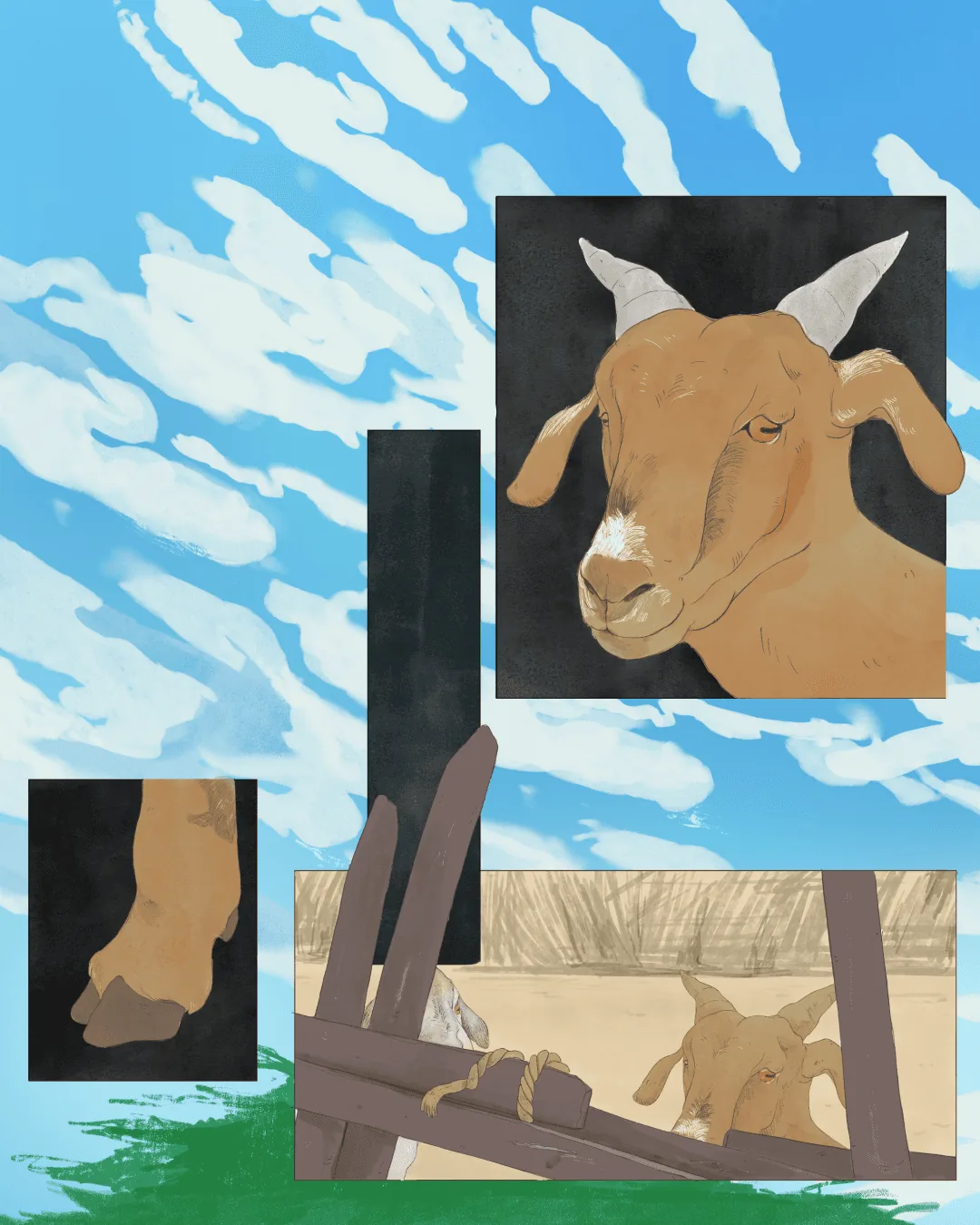
The family owns nearly a hundred goats and sheep together. Three cows and two calves. Ayya’s and his wife’s life is punctuated with that of their livestock. His lifetime has been spent in search of pastures and fodder for his herd. I realized this because he spoke with words the routes of villages and towns of about three districts of southern Tamil Nadu i.e, Thoothukudi, Tirunelveli, and Tenkasi, which Google Maps shows you as a zoomed-out top-view outline.
Though we digressed back and forth, I loved when Ayya casually replied to one of my questions about the rules in animal slaughtering for a deity. “There are no such rules. Anybody can slaughter. There are many ways of doing it. Some do it by placing the animal on the ground and striking it in the neck. The other way is to slash it by making it stand straight. There is another way where it is stricken on the chest and the liver is pulled out straight and offered to the god straight. But the best is to slaughter it on the neck in a single stroke and let it be sacrificed without pain.”
Yuga’s mother told me that a priest slaughtering an animal for the deity is the most appropriate. But these days many, who aren’t priests, come drunken, and in a display of power, to slaughter. Her emphasis on slaughtering as a priestly honour, though it translates into no real power or authority over the stakeholders of the shrine, reminded me of Chinua Achebe’s “Arrow Of God” where a powerful and wealthy Nwaka addresses a village assembly of Igbo people that a priest cannot be a king and that his powers are reduced to offering sacrifices to the deity, in a move to direct the assembly to a war with their neighbours without their chief priest’s approval. There as well, the society circles around markets, meek harvests, and meaty sacrifice for deities. Achebe’s Igbo people in the forest, under the blanket of the British, are so unlike the herder family I’m acquainted with in 2026 rural India. But the commonness of priestly power exercised by the act of slaughtering is a testament to human societies fixation with power performance, especially through food. Though I read the book many moons back, references through the gap in power and titularity of priesthood circling around slaughtering an animal took me back to the pages of Achebe. In both the cases, power is held somewhere else but the priest is expected to perform power, mainly through animal sacrifice.

Now markets have evolved and have gone beyond grasp, priest powers have long been overridden by new forms of wealth and power in newer forms of economy, be it Africa or India. But the little remnants, as archives of practice, are not anachronistic but microcosm to the mammoth society it is surrounded by. “It brings huge terror and violence in our settlements and community when someone makes fun of someone else’s style of slaughtering. When the blood is young and hot you are ready to spend time and energy on things of no good use”, Ayya tells me to confirm the dangers of serious displays of corporal masculinity involved in ritual slaughter.
“Of no good use” – did I come to hear these words from him? Of such matters of trivial importance? The deed or the gesture to which I pay so much attention to is a matter “of no good use” to a herder. Ayya didn’t intentionally say so. He said it in passing very much later towards the end of our chat, by the time he sure forgot the first jog of our exchange.
The unexpected trivialisation of turning life into food, animal to carcass, pet to sacrifice by a herder who knows the animal like none, mainly its mere eaters, caused me a tiny shock. I wasn’t expecting the exchange between us to create a shift in my philosophy of meat. But I didn’t know this momentary shock was awaiting in passing.